



Sitemap
Vision Creates Future

For outdoor lifting assignments, successful equipment selection hinges on alignment with site surroundings, power demands and project targets. Zoomlion Access knows full well that deciding between diesel and electric boom lifts cannot be based merely on lifting height. Terrain conditions, daily operating durations, local emission standards and lifecycle maintenance costs all weigh heavily in the selection process. By evaluating the pros and cons of each option, we empower customers to zero in on the most appropriate equipment for diverse outdoor applications.
Power Performance: Diesel and Electric Solutions for Different Demands
When outdoor projects involve challenging terrain, long working hours, or heavy-duty operations, power performance becomes a key consideration. A diesel boom lift generally provides strong driving capability and stable operation in open environments where power availability is not limited.
Our ZA14J diesel articulating boom lift is designed for precise positioning and flexible outdoor operation. It offers a maximum working height of 15.8 meters, a platform capacity of 300 kg, and four-wheel drive capability, making it suitable for demanding job sites.
Electric boom lifts focus on efficient operation with lower noise and cleaner energy use. They are often preferred for projects where environmental requirements are stricter or where the machine operates near occupied areas. For outdoor applications close to commercial buildings, facilities, or urban locations, electric power can provide practical advantages.
The choice between diesel and electric power depends on whether the project prioritizes mobility and endurance or low-emission operation and quiet performance.
Emissions and Environmental Considerations
Environmental requirements are becoming an important factor when selecting aerial work equipment. Diesel-powered machines use combustion engines, which means they produce exhaust emissions during operation. However, they remain widely used for outdoor construction, infrastructure work, and industrial maintenance where ventilation is naturally available.
Electric models reduce direct emissions during operation and can support projects with stricter environmental standards. They are especially suitable for areas where noise control and air quality management are important.
For contractors managing mixed project types, understanding these differences helps create a more efficient equipment strategy. Diesel models remain valuable for remote or rugged outdoor locations, while electric models provide advantages in cleaner working environments.
Operating Cost: Fuel, Maintenance, and Long-Term Value
Cost evaluation should include both initial investment and long-term operation. Diesel boom lifts typically require fuel management, engine maintenance, and regular servicing of mechanical components. However, they can deliver extended working periods without charging limitations.
Electric boom lifts usually have lower energy costs and fewer engine-related maintenance requirements. Their operating expenses can be reduced in projects with frequent daily usage, especially where charging infrastructure is available.
As experienced boom lift manufacturers, we consider total ownership costs when developing access equipment. The best choice is not always the machine with the lowest purchase price, but the one that delivers reliable productivity throughout its service life.
Job Site Conditions: Matching Equipment to Outdoor Applications
Different outdoor environments require different equipment characteristics. Construction sites, steel structures, warehouses, and infrastructure projects often involve uneven surfaces, long travel distances, and changing work positions.
Diesel models are commonly selected for these conditions because they can provide strong traction and operational flexibility. The ZA14J, for example, includes features such as a load sensing system, stability control design, and available hostile environment kits for demanding working conditions.
Electric boom lifts are more suitable for organized outdoor sites with stable ground conditions and planned access routes. They can support maintenance tasks, facility management, and projects where reducing operational impact is a priority.
Before selecting equipment, we recommend evaluating terrain, working height, movement frequency, and environmental requirements.
Flexibility and Reach: Choosing the Right Boom Lift Type
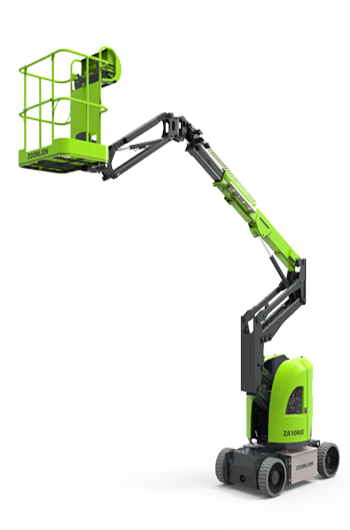
Reach capability is another important difference between equipment options. Articulating boom lifts provide flexible positioning because their boom structure allows operators to reach over obstacles and access complex areas.
Diesel articulating models are often selected for outdoor projects requiring both height and horizontal outreach. The ZA14J provides a horizontal outreach of 8.3 meters and an up-and-over height of 7.55 meters, supporting work in areas with access challenges.
Electric versions can provide similar positioning advantages while reducing noise during operation. This makes them suitable for applications such as exterior building maintenance, landscaping, and facility upgrades.
Selecting the correct boom structure and power system ensures better productivity and reduces unnecessary equipment limitations.
Making the Right Decision for Your Outdoor Project
There is no single solution that fits every outdoor application. Diesel and electric boom lifts each provide different advantages based on working conditions, operational priorities, and project requirements.
Diesel equipment is often the better choice for rugged terrain, extended operation, and locations where mobility is critical. Electric equipment is better suited for projects that require quieter operation, lower emissions, and efficient energy use.
At Zoomlion Access, we combine engineering experience with practical application knowledge to help customers choose suitable aerial work platforms. Our solutions cover different access requirements, and our team supports customers in evaluating equipment selection, maintenance planning, and project needs.
Partnering for Smarter Aerial Access Decisions
At Zoomlion Access, we provide professional aerial work equipment supported by engineering expertise, product development capabilities, and global service resources. Our product portfolio is designed to meet different application requirements across construction, industrial maintenance, and infrastructure projects.
For businesses looking for dependable equipment sourcing and long-term cooperation, our services include product consultation, customized solutions, technical support, and after-sales assistance. By working closely with customers, we help identify suitable diesel or electric boom lift options based on project conditions, operational requirements, and investment goals.
If you have any questions, please feel free to leave us a message