



Sitemap
Vision Creates Future

A mobile elevating work platform (MEWP) puts people, tools, and material into the air on a moving machine, which is exactly why it sits under one of the most developed bodies of safety rules in the access equipment world. For employers and fleet owners, MEWP compliance is a continuous obligation that touches three things at once: the safety of the people in the basket, the legal exposure of the business that owns or operates the machine, and the market value of the asset itself.
This guide explains what MEWP safety compliance actually covers, then walks through the rules that apply in North America, Europe, and the UK, and the wider international market, before showing how a manufacturer's range maps onto those frameworks.

North America runs on a layered system: voluntary technical standards sit on top of legally enforceable workplace regulations.
The ANSI/SAIA A92 suite
The governing standards in the US are the ANSI/SAIA A92 suite, three complementary documents that map onto the three pillars:
● ANSI A92.20 — design and build requirements for the manufacturer
● ANSI A92.22 — safe-use requirements for owners, users, supervisors, and operators
● ANSI A92.24 — training requirements for operators, supervisors, and occupants
This suite took effect on June 1, 2020, replacing the older type-specific standards (A92.3, A92.5, A92.6), and the design and safe-use documents were subsequently republished in August 2021.
Design markers on the machine (A92.20)
The 2020 design standard introduced several visible changes that fleet owners use as quick compliance markers: platform load-sensing systems that alarm and inhibit function before the rated load is exceeded, tilt and chassis-angle sensing that shuts down lift and drive functions when the machine is out of level, wind ratings on the machine's ID plate, taller guardrails (43.5 inches versus the previous 39.5), and entrance gates with toe boards replacing the old chain entries on many machines. None of these features is retroactive, so a mixed-age fleet will contain machines built to different design baselines — a record-keeping point owners need to track.
Owner and operator duties (A92.22 / A92.24)
The use-side rules require trained and authorized operators, trained supervisors, and basic instruction for occupants; familiarization on the specific make and model before use; a documented prestart inspection; and a periodic inspection (within 13 months under the standard). They also require a task-specific risk assessment and a rescue plan for retrieving a worker stranded at height. ANSI does not fix a single retraining interval, but a roughly three-year refresher cycle is the common employer practice, with retraining also triggered by unsafe behaviour, equipment changes, or new site conditions.
The Enforceable Layer: OSHA
The enforceable layer is OSHA, primarily 29 CFR 1926.453 for aerial lifts in construction and 29 CFR 1910.67 for general industry, backed by the General Duty Clause. In practice, OSHA frequently references the current ANSI standards when assessing whether an employer met its duty of care, which is why treating A92 as the working baseline is the safer position even though it is technically voluntary.
The CSA B354 series
Canada's equivalent is the CSA B354 series, which mirrors the same three-pillar structure:
● B354.6 for design
● B354.7 for safe use
● B354.8 for training
The series was deliberately aligned with ANSI A92, so the machine design markers and the operator, supervisor, and occupant duties described above for the US apply in close parallel in Canada, a machine built to B354.6 and a program built to B354.8 carry over with minimal adjustment.
Enforcement: Provincial OHS
The key difference is the legal layer. Canada has no federal OSHA equivalent for most workplaces; occupational health and safety is regulated province by province, each with its own OHS act and inspectorate. So while the technical standard is shared with the US, the enforceable duties, documentation expectations, and operator licensing details are jurisdiction-specific — an owner operating across several provinces must confirm the local OHS requirements for each, even for identically certified machines.
Europe takes a different route to the same destination. Rather than a voluntary standard sitting above a separate regulation, the EU ties market access directly to conformity. And the UK, since leaving the EU, runs a closely related but separate framework of its own.
The EU ties market access to CE marking: a manufacturer affixes the CE mark to declare that a machine meets the EU's essential health and safety requirements, and only compliant, CE-marked machinery may be placed on the internal market and moved freely within it.
The technical backbone for MEWPs is the harmonized design standard EN 280, building a machine to EN 280 is the established route to demonstrating conformity for the CE mark.
The legal basis underneath CE marking is changing, and it is the most important date for any owner buying into the European market over the next few years. The current Machinery Directive 2006/42/EC is being replaced by the Machinery Regulation (EU) 2023/1230, which applies from 20 January 2027. Because it is a regulation rather than a directive, it applies directly and identically across all EU and EFTA states without national transposition, reducing the country-by-country variation that exists today.
The new Regulation keeps the great majority of existing requirements but adds detail around digitalization, connected and autonomous machinery, cybersecurity, and high-risk machinery categories.
The United Kingdom runs its own UKCA mark in principle, but after a series of extensions, it has indefinitely continued to recognize CE marking for machinery, so CE-marked equipment remains acceptable in Great Britain. (Noted: Northern Ireland still follows EU rules. )
For a fleet owner moving machines between the EU and the UK, this convergence is helpful, but the underlying framework is still in transition and worth confirming per consignment rather than assuming.
Beyond the two largest blocs, a fleet that travels needs to recognize the wider standards landscape, and most of it is converging.
The international reference standards come from ISO Technical Committee 214:
● ISO 16368 for design, calculations, and test methods
● ISO 18878 for operator (driver) training
● ISO 18893 for safe use
The North American A92 suite was rebuilt around this ISO model, which is also closely related to Europe's EN 280. That means a machine engineered to satisfy one major market is usually close to satisfying the others, with regional deltas rather than wholesale redesigns.
Australia applies AS 1418.10 as its design standard for elevating work platforms, alongside its own work-health-and-safety duties for use and operator licensing.
MEWP compliance defines the threshold at which a machine is fit to carry a worker at height, and they serve as the reference against which regulators, insurers, and courts assess an operation after an incident.
For an employer, MEWP compliance is first a duty of care. The people in the platform are working at height, and the law in every market covered here holds the employer responsible for training them, inspecting the machine, and planning for rescue. Falling short does not just raise the odds of an incident; it invites citations and liability that land on the business regardless of how new the equipment is.
For a fleet owner, MEWP compliance governs the asset. A machine certified to its market's standard can be rented, hired out, and resold; a machine outside the recognized standard — wrong market, lapsed inspection, undocumented history — loses utilization and resale value even while it still runs.
So selecting a MEWP manufacturer whose machines already hold the certifications is more important than ever. Zoomlion Access is one of the leading manufacturers around the world, built around that test, designed for a fleet that crosses borders rather than for a single home market.
Zoomlion Access builds its MEWP range against the major regional frameworks rather than a single home market. The MEWP equipment manufactured by Zoomlion Acces carry CE, ANSI, CSA, AS, EAC, and KC certifications, and is sold across more than 100 countries and regions. That multi-standard approach is what lets a single supplier serve a fleet operating under EN 280 in Europe, ANSI A92 in the US, CSA B354 in Canada, and AS 1418.10 in Australia without forcing an owner to source different machines for each jurisdiction.
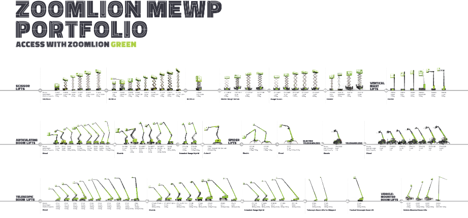
By Zoomlion Access, employers and fleet owners has lower risk, because a machine certified to the destination market's standard is defensible in inspection and after an incident. And Zoomlion Access’s design features — load sensing, tilt sensing, wind rating, modern guardrails, and gates — are also match the current standards. It protects residual value, because a machine that still meets the recognized standard of its market remains rentable and resellable rather than stranded. And it supports utilization, because a fleet whose paperwork and approvals are in order spends less time idle waiting on documentation.
MEWP compliance is not a certificate filed at purchase but a discipline that spans a machine's entire working life, and the decision that most determines its cost is choosing equipment certified to the markets that the machine will work in. Get that right, and compliance ceases to be overhead and becomes a lever for lower liability, protected resale value, and higher utilization.
Zoomlion Access builds the MEWP equipment range to CE, ANSI, CSA, AS, EAC, and KC standards across more than 100 countries and regions, with the conformity documentation to back it in each market. Talk to our team about specifying a fleet that stays compliant, wherever it operates!
If you have any questions, please feel free to leave us a message