



Sitemap
Vision Creates Future

A telehandler — short for telescopic handler — is a versatile piece of material handling equipment that combines the lifting reach of a crane, the ground mobility of a forklift, and the load-handling flexibility of a loader.
At its core, it is a wheeled machine fitted with a telescopic boom that extends forward and upward, allowing operators to lift, carry, and place loads at heights and horizontal distances that most single-function machines simply cannot reach.
Unlike a standard forklift, which lifts loads vertically along a fixed mast, a telehandler can project its boom outward over obstacles or into hard-to-reach positions. Unlike a crane, it is self-propelled and requires no fixed base or rigging setup.
This combination makes it one of the most productive machines on construction sites, agricultural operations, and industrial facilities worldwide.
Understanding what a telehandler is means recognizing that it is not a forklift with a longer arm. It is a mobile elevating work platform (MEWP) designed for dynamic environments where reach, mobility, and load capacity must all be available at once
— on the same piece of equipment, on the same shift.
What are the Types of Telehandlers?
The market offers several distinct categories, each engineered around specific operational demands. Knowing the types of telehandlers available helps procurement teams match the right machine to their site conditions,
load profiles, and space constraints.
1.Compact Telehandlers
Compact telehandlers are built for tight spaces, narrow aisles, and enclosed work environments such as indoor or open-air warehouses and distribution centers.
Their reduced footprint allows them to maneuver where larger machines cannot, without sacrificing meaningful lift height or load capacity (around 1 to 2 tons). They are a practical choice wherever material handling must happen in restricted or indoor settings.
2.Standard Construction Telehandlers
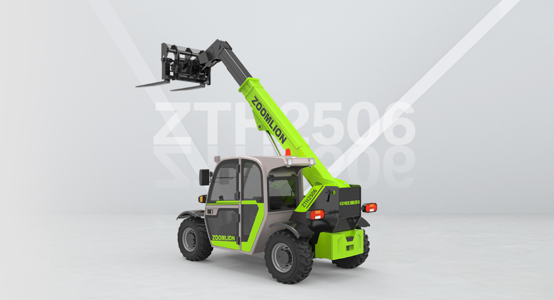
Standard construction telehandlers are the most widely deployed category across general jobsites. They offer a balanced combination of lift height, forward reach, and load capacity —
typically 2 to 4 tons — making them suitable for framing, roofing, landscaping, and general material placement on mid-scale construction projects.
3.Heavy-Duty Telehandlers
Heavy-duty telehandlers are built for high-capacity industrial lifting where standard models reach their limits.
These units can carry loads exceeding 4 tons and extend to heights above 20 meters, making them essential for heavy civil construction, energy infrastructure, and large-scale industrial maintenance.
4.Rotating Telehandlers
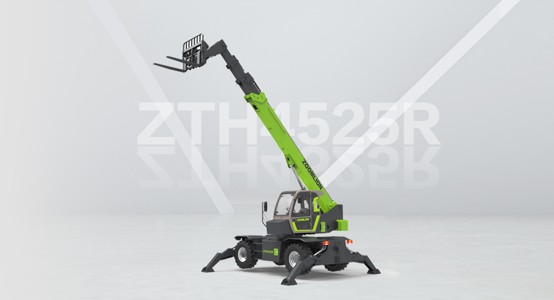
Rotating telehandlers feature a 360-degree turret that allows the boom to swing in a full circle without repositioning the chassis. This design significantly increases operational flexibility on tight or irregular sites, where driving into a new position takes time the project cannot afford.
They are widely used in urban construction, utilities work, and confined industrial environments.
How a Telehandler Works?
The working principle of a telehandler centers on three integrated systems:
The telescopic boom
The hydraulic circuit
The chassis
The telescopic boom consists of two or more nested sections extended by hydraulic cylinders. As the operator adjusts boom angle and extension simultaneously, the machine can place a load at a precise height and horizontal distance.
The boom also tilts to keep forks or attachments level during travel and final placement.
The hydraulic system drives every major function — boom extension, elevation, tilt, and attachment operation. It must deliver consistent pressure across all movements, often at the same time. Hydraulic performance is directly tied to oil viscosity and operating temperature,
which is why cold-weather conditions place a particularly high demand on this system.
The chassis provides four-wheel drive and, in most models, three steering modes: two-wheel, four-wheel, and crab steering. This gives the telehandler the off-road mobility to operate on uneven terrain, soft ground, and graded surfaces while maintaining stability under full load.
Telehandler vs. Other Lifting Equipment: What are the Differences?
One of the most common points of confusion when evaluating what is a telehandler is how it compares to other lifting and access machines available on the same jobsite.
1.Telehandler vs. Forklift
A forklift lifts loads vertically along a fixed mast, designed primarily for flat, hard surfaces with short horizontal distances.
A telehandler extends its boom outward and upward, offering far greater reach and significantly better performance on rough terrain.
2.Telehandler vs. Boom Lift
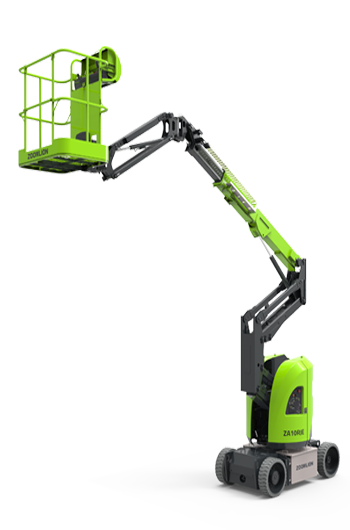
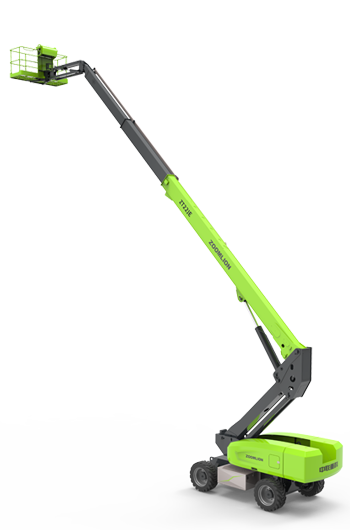
A boom lift — articulated or telescopic — is designed first and foremost for personnel access, not for moving heavy loads.
A telehandler, by contrast, is a load-handling machine that can accept a work platform attachment for occasional personnel lifting.
3.Telehandler vs. Scissor Lift
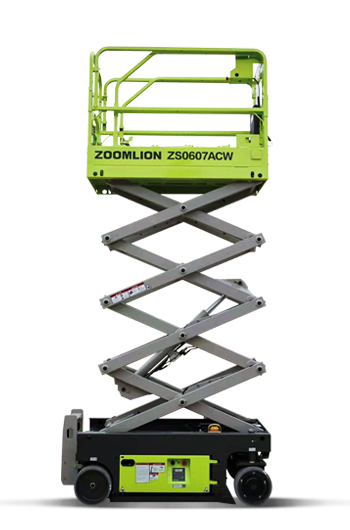
Scissor lifts raise personnel and light tools straight up on a vertical mechanism. They provide excellent platform stability at height but offer zero horizontal reach.
Telehandlers can extend its boom outward over obstacles and place loads at offset positions — a capability that is entirely outside the scissor lift's design scope.
Above all, when the task requires reach, mobility, and load capacity on the same machine, the telehandler is the most practical option available.
Zoomlion Access Telehandlers: A General Overview
Having covered what a telehandler is, how it works, and how it compares to other lifting equipment, here’s a one more thing: telehandlers could vary considerably across manufacturers in terms of capacity, reach, and design maturity.
In the market, Zoomlion Access can offers a telehandler lineup built around off-road capability, intelligent controls, and broad attachment compatibility according to the demand. Models span from compact units suited to logistics and agriculture up to heavy-duty rotating configurations reaching beyond 20 meters in working height, with platform capacities up to 4,500 kg. Besides, all models are CE certified and designed for deployment across international markets, including regions where cold, snow, and ice are routine operating conditions rather than exceptions.
Zoomlion Access’ Telehandler Winter Test
Cold environments place demanding stress on every system a telehandler relies on. Hydraulic fluid thickens at low temperatures, reducing response speed and output pressure. Battery performance drops, affecting electric and hybrid powertrains. Metal components contract, tightening tolerances across structural joints and moving parts.
For buyers operating in these environments, validated cold-weather performance is a procurement consideration as important as lift height or rated capacity.
In late January, 2026, Zoomlion Access conducted a 15-day extreme cold weather test at the Heihe Honghegu Automotive Testing Center along the Nenjiang River, with temperatures reaching -30°C. Five MEWPs and telehandlers — covering diesel, hybrid, and electric powertrains — were subjected to snow, ice, wet surfaces,
and repeated start-stop cycles to validate reliability and stability under genuine winter conditions.
The test covered three critical areas. On cold start reliability, all machines — including the ZTH4014 diesel telehandler — started successfully without auxiliary heating, with engineers further evaluating recovery after prolonged cold exposure and repeated restart cycles.
On snow and ice handling, steering, braking, maneuverability, and tire traction were assessed on naturally frozen surfaces, with the equipment maintaining stable power output throughout. On aerial work stability, boom extension, outreach, slewing, and platform control were monitored closely, as low temperatures can affect hydraulic response,
structural movement, and sensor accuracy — all functions performed reliably across the full program.
For buyers sourcing telehandlers for cold-climate infrastructure, mining, or large-scale industrial projects, this kind of structured field testing provides a concrete basis for equipment decisions.
Conclusion
A telehandler is one of the most adaptable and productive machines available to construction and industrial operations today. Selecting the right model requires more than matching headline lift specs to project requirements.
It means understanding the types of telehandlers available
the regulatory context around their use, how they compare to alternative equipment, and — critically — how they hold up in the environmental conditions your projects actually face.
The Zoomlion Access winter test is a clear example of how leading telehandler manufacturers validate their equipment beyond standard benchmarks. That level of real-world verification is a practical filter worth applying to any major equipment sourcing decision.
Contact Zoomlion Access today to get more information about telehandlers!
If you have any questions, please feel free to leave us a message