



Sitemap
Vision Creates Future

The first failure category covers the systems that start the machine and keep its electronics responsive. Cold weather degrades all of them in predictable ways.
1. Common Failure Modes
l Diesel and hybrid MEWP equipment loses cranking power as battery chemistry slows.
l Electric MEWP battery packs show voltage drop under load, sometimes severe enough to trigger fault codes mid-shift.
l Moisture and frost create corroded or loose terminals, especially on machines that move between heated storage and outdoor work.
l Control modules and displays respond sluggishly in cold, and operators may misread the lag as a software issue when the root cause is electrical.
2. How to Prevent It?
l Insulated battery compartments protect both lead-acid and lithium chemistries from the worst of the cold. They also reduce thermal cycling, which shortens battery life across multiple winter seasons.
l Scheduled charging the MEWP equipment battery during off-hours keeps state of charge high. A fully charged battery resists freezing better than a partially depleted one, and the electrolyte stays within its working range.
l Terminal maintenance — cleaning, tightening, and protective coating — eliminates a common cause of intermittent fault codes during MEWP operation. Monthly inspection is the minimum standard for winter fleets.
The hydraulic system on any hydraulic aerial work platform is the most temperature-sensitive subsystem on the machine. Cold transforms how fluid moves, how seals behave, and how pumps perform under load.
1. Common Failure Modes
l Fluid viscosity rises sharply below freezing, and boom response slows noticeably during the first lifts of the day. The control inputs feel the same to the operator, but the boom takes longer to react.
l Seals shrink in extreme cold and produce minor leaks at fittings and cylinder rods. The leaks often appear during the first warm-up of the shift and fade once the system reaches operating temperature, which can hide a growing problem.
l Pump cavitation occurs during cold starts when thick fluid struggles to reach the inlet at the rate the pump demands. Cavitation damages the pump impeller and shortens its service life with each occurrence.
l Condensation and moisture accumulate in reservoirs across repeated temperature cycles. Water in hydraulic fluid causes accelerated wear and internal rust on cylinders, valves, and pump components over time.
2. How to Prevent It?
l Cold-rated hydraulic fluid maintains flow characteristics down to the machine's stated operating temperature. The fluid grade should be selected against the lowest expected ambient temperature, not the seasonal average.
l Warm-up cycles — running the boom, slewing, and platform functions at low speed before lifting — circulate fluid through every line. The system reaches a working state gradually rather than under load shock.
l Regular moisture checks on the reservoir catch water contamination early. Drained samples reveal contamination before it damages pumps and valves, and the test takes only minutes during scheduled maintenance.
Diesel-powered MEWP equipment depends on a tight sequence of fuel delivery, ignition, and lubrication. Cold weather can disrupt that sequence at every step.
1. Common Failure Modes
l Engine oil thickens at low temperatures and restricts lubrication during the first seconds after startup, when wear risk is highest. Cold-thickened oil also raises starter motor load and drains the battery faster.
l Diesel fuel can gel and block filters and lines if the fuel grade does not match the climate. Once gelling occurs, the fuel system has to be warmed through before the engine will run cleanly.
l Glow plug or block heater failure leaves the engine without the pre-warming it needs for clean combustion. Cold starts without these aids produce hard starts, white smoke, and increased mechanical stress.
l Incomplete combustion produces excessive exhaust smoke and reduced power output. The smoke often signals an underlying fueling or temperature problem rather than a faulty engine.
2. How to Prevent It?
Winter-grade fuel with a lower cloud point keeps diesel flowing through filters and injectors in deep cold. The grade should be matched to the lowest expected operating temperature in the region.
l Fuel additives provide an extra margin where temperature swings are unpredictable. Anti-gel additives protect against unexpected cold snaps that fall below the rated fuel grade.
l Block heaters bring the engine up to a temperature where oil flows freely and combustion runs clean. Plug-in time of two to four hours is typical for severe cold conditions.
l Proper idle time after startup allows oil pressure to stabilize before load is applied. Operators who skip this step accelerate wear on bearings, valve gear, and turbo components.
The fourth failure affects how MEWP equipment moves across the site. Cold weather alters every contact point between the machine and the ground.
1. Common Failure Modes
l Tire pressure drops as ambient temperature falls, sometimes by 1 psi for every 5°C decrease. A 20°C overnight swing can take a properly inflated tire below its rated operating range.
l Rubber compounds harden in deep cold, and grip on ice and packed snow degrades well before tread wear becomes a factor. A new tire on cold rubber performs worse than a half-worn tire on warm rubber.
l Differentials and transmissions show sluggish shifts when their lubricants thicken. Frozen condensation in the housings worsens the issue and can prevent full engagement of certain gears.
l Drivetrain components accelerate wear under repeated stress from icy-surface traction loss. Each loss-of-traction event creates a shock load that propagates through axles, joints, and bearings.
3. How to Prevent it?
l Winter tire inspection covers tread depth, sidewall condition, and signs of cold-cracking on the sidewall and shoulder. Cracked rubber that survived summer can fail under cold flex stress.
l Pressure checks at the start of every shift catch the silent drop that cold weather causes. The check takes a minute per tire and prevents traction issues that cost far more to recover from.
l Appropriate gear selection — using lower gears for slow controlled movement on ice — reduces shock loading on the drivetrain and improves operator control during MEWP operation on slick surfaces.
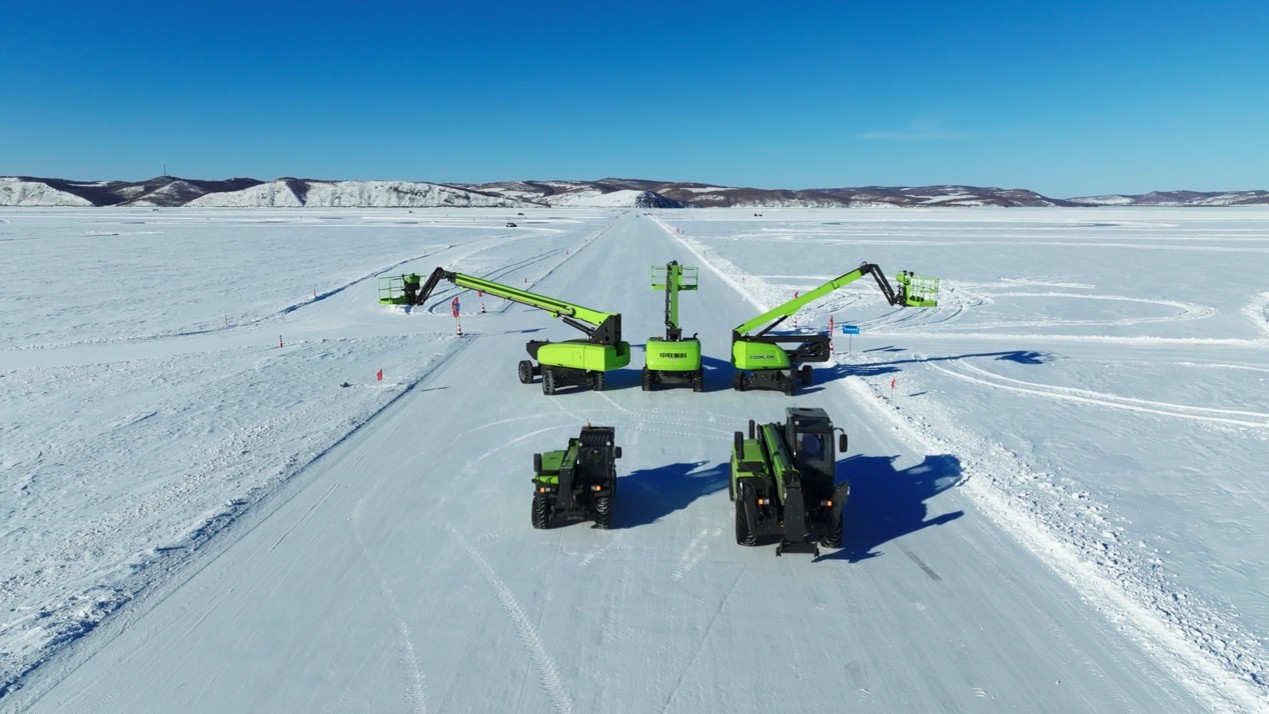
Failures mentioned above has the same underlying prevention: equipment designed and validated against the conditions it will face in service. Zoomlion Access has built that validation into MEWP equipment development through a 15-day extreme cold weather testing program at the Heihe Honghegu Automotive Testing Center, where ambient temperatures regularly fall below -30°C.
Diesel, electric, and hybrid models complete cold starts without auxiliary heating, including the ZTH4014 diesel telehandler. Hydraulic boom, outreach, and slewing functions hold smooth response throughout the temperature range. Steering, braking, and traction remain controlled on natural snow and ice surfaces. Zoomlion engineers stay on site through the full test cycle to document performance and capture any anomaly the moment it appears.
This level of evidence gives a substantive basis for procurement decisions. Fleet planners can map the failure patterns from this checklist against documented test results for each candidate machine, with the data available for review before the purchase order is signed.
Winter failures rarely surprise an operator who knows the four categories to watch and the prevention steps that hold them back. The pattern is consistent across MEWP fleets in every cold-climate market: electrical degradation, hydraulic sluggishness, engine cold-start issues, and drivetrain stress. Each category shows warning signs before failure occurs, and each has prevention measures that fit inside a normal maintenance schedule.
Operators who build cold-weather inspection into the daily routine keep their machines productive across the season. The advantage carries further when the equipment itself has been validated for the conditions, as Zoomlion Access does through its Heihe cold-weather testing program. Procurement teams that draw on this kind of evidence make sharper fleet decisions cycle after cycle.
Contact Zoomlion Access today to get more information about MEWP equipment!
If you have any questions, please feel free to leave us a message