



Sitemap
Vision Creates Future

A diesel boom lift is rarely an impulse purchase. It is a capital asset that sits on a balance sheet for years, gets billed by the hour on rental fleets, and either keeps a crew productive or holds a project hostage when it cannot reach the work. In 2026, that calculation has only become sharper. Machine prices, parts availability, and total cost of ownership now weigh as heavily in a buying decision as raw lift height, and the gap between the right model and the wrong one shows up directly in project margins.
Diesel still anchors the category for a reason. While electric and hybrid platforms continue to gain ground for indoor and emissions-sensitive sites, the diesel boom lift remains the default for outdoor construction, infrastructure, and heavy maintenance work, where runtime, rough-terrain mobility, and power matter more than zero local emissions. The two questions that decide most purchases have not changed: which boom type fits the worksite, and which specific model delivers the reach, capacity, and durability the job demands.
This article answers both. It identifies the best diesel boom lift in each of the two main categories for 2026, compares them on the specifications that actually drive a purchase decision, and walks through the criteria procurement teams should evaluate before committing budget!
Articulating or Telescopic: Which Boom Type Fits Your Site?
First, match the machine type to the work. The single most important distinction in the boom lift category is between articulating and telescopic designs, and choosing the wrong one is the most expensive mistake a buyer can make.
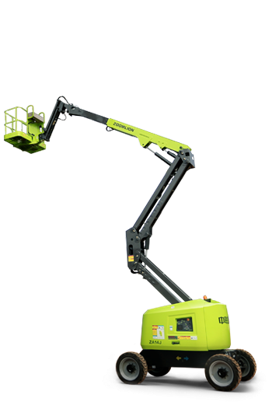
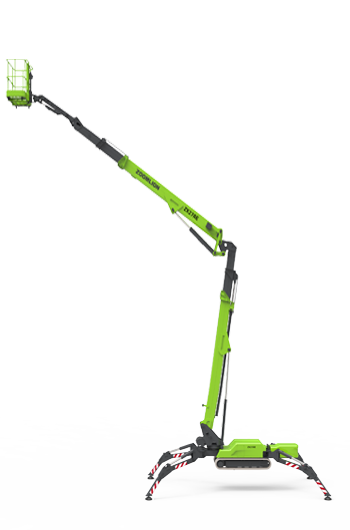
A diesel articulating boom lift uses a jointed, multi-section boom that bends at one or more points. That articulation lets the platform move up, out, and back in — reaching over walls, around steel, and into recessed spaces a straight boom cannot touch. The defining capability is "up-and-over" clearance: getting the platform over an obstacle and then back down to work behind it. Articulating booms trade some maximum horizontal distance for this flexibility, which makes them the natural fit for congested sites, building maintenance, and any application where the obstruction sits between the machine and the task.
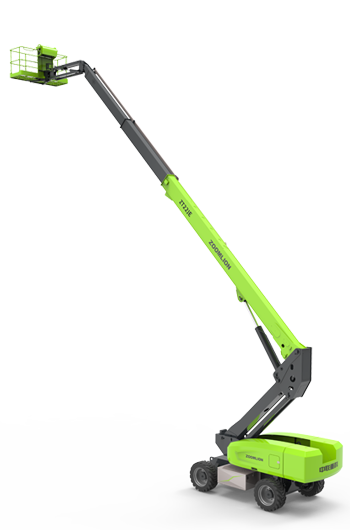
A diesel telescopic boom lift uses a straight boom that extends like a sliding antenna. It sacrifices the ability to reach around obstacles in exchange for the longest possible straight-line reach, both vertically and horizontally. When a crew needs to stand off from a structure and still touch a point far overhead — façade work, steel erection, or high-bay industrial maintenance — the telescopic design delivers reach that an articulating unit of comparable size cannot match.
How to choose: Choose articulating when the work is obstructed and access is the problem; choose telescopic when the work is open and distance is the problem.
The Best Diesel Boom Lifts in 2026
For 2026, one model leads each category -- both come from Zoomlion Access:
l Best Articulating Diesel Boom Lift: Zoomlion Access ZA14J
l Best Telescopic Diesel Boom Lift: Zoomlion Access ZT26J
Specification | ZA14J | ZT26J |
Boom Type | Diesel articulating boom lift | Diesel telescopic boom lift |
Max. Working Height | 15.80 m | 28.20 m |
Max. Platform Height | 13.80 m | 26.20 m |
Max. Horizontal Outreach | 8.30 m | 23.31 m |
Up-and-Over Height | 7.55 m | — |
Platform Capacity | 300 kg | 300 kg (unrestricted) / 454 kg (restricted) |
Turntable Rotation | 355° non-continuous | 360° continuous |
Platform Rotation | 180° | 180° |
Jib | Yes (1.24 m) | Yes (130° vertical rotation) |
Drive System | Oscillating axle | 4WD + oscillating axle |
Gradeability | — | 45% |
Stowed length × width × height | 6.57 × 2.30 × 2.27 m | — |
Power | Diesel | Diesel (Kubota engine) |
Zoomlion Access ZA14J — Built for Access around Obstacles
The ZA14J is the pick for jobs that demand flexibility rather than raw reach. With a 15.80 m working height, 8.30 m of horizontal outreach, and a 7.55 m up-and-over clearance, it is engineered to place a platform exactly where a straight boom cannot — over a parapet, around structural steel, or into the recesses of a building exterior.
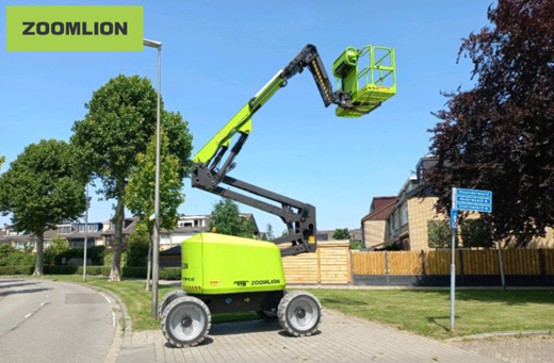
Its compact stowed footprint of 6.57 m by 2.30 m matters as much as its reach. On constrained sites, the ability to transport, position, and maneuver a machine through gates, around scaffolding, and between obstacles is often the difference between a unit that works and one that sits idle. The oscillating axle keeps all wheels in contact on uneven ground, and a 355° non-continuous turntable swing combined with 180° platform rotation lets operators fine-tune position without repositioning the chassis.
The 300 kg platform capacity supports two workers plus tools and materials, which covers the large majority of maintenance and installation tasks. For procurement teams supplying crews who spend their day working around obstructions, the ZA14J is the most capable diesel articulating boom lift in its class.
Zoomlion Access ZT26J — built for high-reach outdoor work
The ZT26J is the pick for jobs where both height and horizontal distance are constraints. A 28.20 m working height paired with 23.31 m of horizontal outreach gives crews a working envelope suited to steel erection, façade installation, and industrial maintenance where the machine must stand well clear of the structure.[TW1]
Capacity is where this model separates itself from heavier trades. The dual rating of 300 kg unrestricted and 454 kg restricted means the platform can carry not just two workers but a meaningful load of tools and materials, reducing trips and keeping productive time on the platform rather than on the ground. A 360° continuous turntable, 180° platform rotation, and a jib with 130° of vertical movement give operators precise positioning across the full working range.
Outdoors, mobility is decisive. Four-wheel drive, an oscillating axle, and 45% gradeability let the ZT26J move confidently across rough, sloped, and unprepared terrain — the conditions that define most outdoor construction sites. Powered by a Kubota engine, it is positioned as the best telescopic diesel boom lift for buyers whose work lives on open, demanding ground.
What Should You Evaluate Before Buying?
The two models above are strong defaults, but every site is different. These are the criteria that should drive any diesel boom lift decision.
1. Working Height and Horizontal Outreach
Specifications are quoted as maximums, and the two figures are not independent — a boom rarely delivers full height and full outreach at the same time. Buyers should map the actual work envelope against the tasks the machine will perform most often, not against the single highest number on the data sheet. Specify for the reach the job needs in practice, with a sensible margin, rather than over-buying height that adds cost and transport weight without adding utility.
2. Platform Capacity: Unrestricted Versus Restricted
A single capacity figure can be misleading. Many machines, including the ZT26J, carry a dual rating, an unrestricted capacity available across the full working range, and a higher restricted capacity available only within a reduced envelope. For crews that carry heavy materials to height, the restricted rating can be the deciding specification, but only if the work falls inside the zone where it applies. Confirm which rating governs the actual task before specifying.
3. Terrain capability
The ground the machine works on dictates its drivetrain. Four-wheel drive, an oscillating axle that keeps wheels grounded on uneven surfaces, and a stated gradeability figure together determine whether a unit can position itself reliably on a real site or gets stranded on the first slope. For outdoor and rough-terrain work, these are not optional features — they are the difference between a usable machine and one that needs towing.
4. Maneuverability
Reach gets a platform to the work; maneuverability gets the machine to the position. Turning radius, stowed dimensions, and up-and-over access decide whether a unit can navigate a congested site at all. A boom with class-leading height is worthless if it cannot pass through the access route or position within the available footprint. On tight sites, the compact stowed envelope of a machine like the ZA14J is a primary specification, not an afterthought.
5. Safety systems
Modern diesel boom lifts integrate load sensing that recognizes overloads before they become incidents, leveling systems that hold stability on difficult ground, and stability control that governs the working envelope. These systems protect the operator and reduce the liability and downtime that follow an incident. Buyers should treat the safety package as a core comparison point, not a checkbox — the cost of an avoided incident dwarfs any price difference between models.
Why Zoomlion Access?
Zoomlion Access has moved from challenger to genuine contender at the front of the aerial work platform industry, and the reason is breadth backed by engineering. Zoomlion Access fields one of the most complete diesel boom lift ranges available, articulating and telescopic, across a wide span of heights, which lets a single supplier cover a fleet's full requirement rather than forcing buyers to mix brands.
That range is paired with design choices aimed squarely at ownership cost. Across the boom lifts, Zoomlion Access builds in load sensing, multiple-pressure leveling, and maintenance-oriented features such as swing-out engine trays that simplify routine service. Lower-maintenance boom systems and accessible serviceability reduce the downtime and labor that quietly erode the economics of an aerial fleet over its working life.
The result is a manufacturer that competes not only on the headline reach and capacity figures buyers compare first, but on the total cost of running the machine after purchase — which is where boom lift value is ultimately decided. For procurement teams weighing the best boom lift options for 2026, Zoomlion Access belongs on the shortlist for exactly that reason.
Conclusion
The temptation in any diesel boom lift purchase is to chase the largest number on the spec sheet. The buyers who get the most out of their capital do the opposite: they define the worksite first — obstructed or open, level or sloped, light or heavy loads — and then specify the machine that fits it.
Get that match right, and a model like the ZA14J or the ZT26J will earn its cost back in productive hours and avoid downtime for years.
So, to match the right diesel boom lift to your site, talk to the Zoomlion Access team! Request a quote or a specification consultation, and get a recommendation built around the reach, capacity, and terrain your project actually demands.
If you have any questions, please feel free to leave us a message